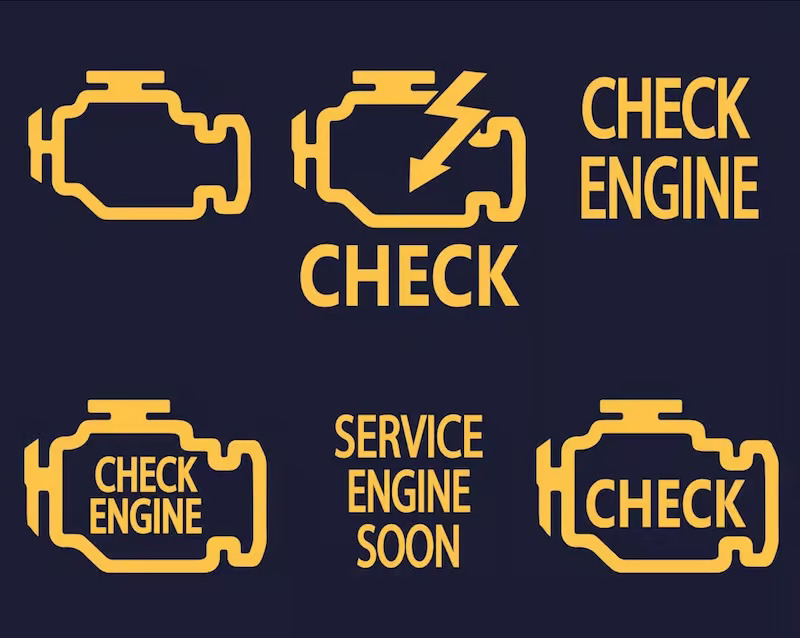
When your car’s Check Engine Light (CEL) flicks on, it’s easy to panic—or worse, ignore it completely. But the light is your vehicle’s way of telling you something’s not quite right. Whether it’s a minor issue like a loose gas cap or something more serious like an internal engine problem, understanding the root cause is the first step to keeping your vehicle running smoothly and avoiding costly repairs.
In this post, we’ll break down a few common reasons your Check Engine Light comes on—and what to do when you hear these issues.
1. Loose or Faulty Gas Cap
Diagnostic Trouble Codes (DTCs): P0455, P0442
Why it happens: A gas cap that isn’t sealed properly can allow fuel vapors to escape, triggering an Evaporative emissions system fault. It’s one of the most common and easiest-to-fix issues. Basically, the vehicle will check the integrity of the fuel system by slightly pressurizing it- and if it detects a leak, It’ll turn the check engine light on.
Symptoms:
- Check engine light on, with no noticeable performance issues.
- Fuel smell around the car (sometimes)
How to fix it:
- Remove the cap, inspect the rubber seal for cracks or debris.
- Re-tighten until it clicks, or replace it if damaged.
- Clear the code with a scanner, or it may reset after a few drive cycles.
2. Faulty Oxygen Sensor
DTCs: P0135, P0141
Why it happens: Oxygen sensors monitor your exhaust gases and help optimize fuel mixture. A failing sensor sends incorrect data, throwing off your fuel economy. BUT THIS ISN’T ALWAYS THE CASE! Oxygen sensors are after the fact- and are only feedback sensors. They could be influenced by air leaks, poor running engines, and other factors- So faults like this should really be assessed by a qualified technician.
Symptoms:
- Increased fuel consumption.
- Rough idling or hesitation.
- Failed emissions test.
Diagnosis:
- Scan for codes and monitor live O2 sensor voltage.
- (some types of) Healthy sensors should fluctuate between 0.1V–0.9V.
Fix: Have a technician assess the situation, because of the complications of Oxygen sensor diagnostics.
3. Failing Spark Plugs or Ignition Coils
DTCs: P0300–P0308
Why it happens: Worn spark plugs or a bad coil can cause one or more cylinders to misfire, reducing power and potentially damaging the catalytic converter. But it turns into “the chicken or the egg”- was it the worn out spark plugs that made the (good) ignition coil go bad, or the ignition coil isn’t firing the (good) spark plug?
Symptoms:
- Engine shaking.
- Loss of power or acceleration.
- CEL flashing (serious misfire).
Diagnosis:
- Use a scan tool to identify the misfiring cylinder.
- Inspect spark plugs for wear, fouling, or oil deposits.
- Swap the ignition coil to another cylinder and see if the issue has migrated.
Fix: Replace the spark plugs and/or ignition coil(s) as needed.
4. Mass Air Flow (MAF) Sensor Malfunction
DTCs: P0101
Why it happens: The MAF sensor measures the air entering the engine. If it’s dirty or failing, your engine may not get the correct air-fuel ratio. The MAF is affected by the oxygen sensors, and other factors, too!
Symptoms:
- Stalling on start.
- Hesitation on throttle.
- Poor fuel economy.
Diagnosis:
- Scan for code P0101.
- Check live airflow readings.
- Inspect the air filter and intake for debris or leaks.
Fix: Clean the MAF sensor with electronics-safe cleaner or replace it.
5. Catalytic Converter Efficiency Below Threshold
DTCs: P0420
Why it happens: Your catalytic converter helps reduce harmful emissions. If it’s not working efficiently, the system detects it via upstream/downstream O2 sensor comparisons. Are we seeing the connection between all 5 of these systems? This is why it’s so important to have a competent shop look at your check engine light- to know what is causing what.
Symptoms:
- Poor acceleration.
- Sulfur or rotten egg smell from exhaust.
- Reduced MPG.
Diagnosis:
- Check oxygen sensor readings before and after the catalytic converter.
- Identical readings suggest converter failure.
Fix: Replace the catalytic converter only when all other systems are corrected! (but check for upstream causes like misfires first).
Final Thoughts: Don’t Ignore the Light
Your Check Engine Light is more than just an annoyance—it’s a warning. For recurring or complex codes, it’s always smart to consult a professional mechanic.
Got a specific code or symptom you’re dealing with? Drop a comment or reach out—I’ll help you decode what your car’s trying to tell you.
We can handle this, flash to bang for you. Just give us a call
832-797-9114 Woodlands
281-579-8885 Katy