We’ve covered a lot already:
Part 1: Why the “$120,000 mechanic job” headline is misleading
Part 2: How politics inside a dealership starve good techs out
Part 3: Why shiny pay plans fall apart once you plug real life into them
Part 4: What the industry would actually have to fix to attract real talent
Now it’s time to turn the camera on you, the driver.
Because there’s one more hard truth:
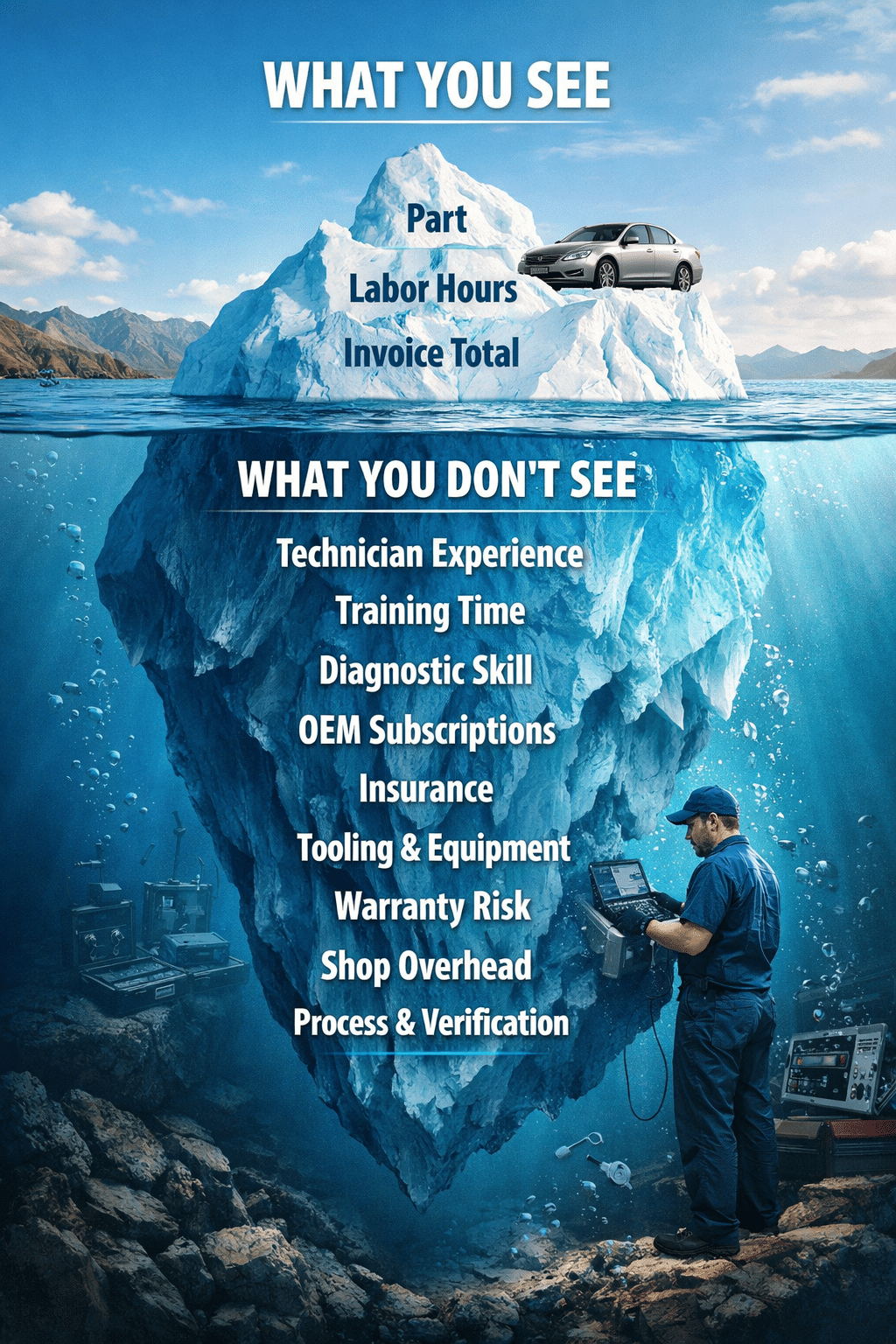
Most people have no clue what they’re actually paying for when they get a car repaired.
They see a big number at the bottom of the invoice and assume:
“Shops must be making a killing. You guys are robbing us.”
No. You’re paying for far more than a part and some labor—and judging shops by price alone is the fastest way to get burned.
Why Repairs “Cost So Much”
Let’s start here: your car is not simple. At all.
Your car is not simple.
Modern vehicles are:
Loaded with computers and networks
Packed with safety systems, emissions controls, and driver aids
Built from materials that don’t tolerate shortcuts or repeat repairs
When something fails, you’re often replacing entire modules, pumps, or assemblies that require programming, calibration, or coding.
Systems don’t fail in isolation. One failure often masks another. Cooling systems are a perfect example: fix one leak, restore pressure, and the next weak point shows itself. That’s not fraud—it’s physics. It would be unprofessional of a shop to say replace a bunch of things, when you have a major leak coming from one location. We really do have your best interest in mind.\
Before blaming the shop, understand this: some repairs are layered, not one-and-done.
That’s before we talk about what it takes to run a legit shop.
The Overhead You Never See
You’re paying for:
People. Skilled technicians, trained advisors, and support staff. Labor is the single largest expense in a legitimate shop.
Environment. Good techs don’t work in sweatboxes with broken fans and oil-soaked floors. Clean, climate-controlled shops are not optional.
Insurance. Liability, garage coverage, workers’ comp, building insurance, loaner insurance. Six figures annually in many shops.
Equipment. Manufacturer subscriptions alone can cost tens of thousands per year. Add diagnostic tools, lifts, alignment machines, tire equipment, and constant maintenance. Easily $300k–$500k invested.
Parts volatility. Post-COVID pricing and availability never fully normalized.
None of this appears as a line item. It’s baked into the labor rate. If it isn’t, corners are being cut—or the shop won’t survive.
“Just Charge Less” Is Not A Plan
Drivers say:
“Everyone’s overpriced.”
Reality
It’s what happens when:
Skilled techs aren’t cheap
Tools aren’t cheap
Training isn’t cheap
Insurance isn’t cheap
Now add risk.
Every new hire is a 60–90 day gamble:
Can they actually do the work?
Will they damage cars?
Will they poison the culture?
The shop pays their wage regardless—and eats the cost if something goes wrong.
That’s why “Chuck-in-a-truck” pricing doesn’t buy professional results.
Cheap is not your friend. Cheap costs more later.
Cheap costs you more in the long run.
Why Price Shopping Fails
Most people compare shops like this:
Shop A: $1,500
Shop B: $1,200
Shop C: $600
Then they say:
“Same job, cheaper at C. Done.”
Wrong. So wrong. You are not comparing identical cans of beans at different grocery stores.
That logic works for canned goods. Not for skilled labor.
You’re not comparing identical jobs. You’re comparing restaurants.
Both menus say “steak.” That doesn’t mean same cut, same cook, same kitchen, or same standards.
Two estimates that both say “replace valve cover gaskets” are not the same repair.
What Might Be Different Behind Those Two Prices
Parts quality
Labor quality
Process of repair
Verification, cleaning, test drive and confirmation
Warranty and support
Overhead
Professionalism of the repair.
On paper, both invoices show the same part number and a labor line. Only one of them protects you from being back in the lobby with the same problem.
What You’re Actually Paying For
When you get a repair bill, here’s what’s really built into it:
1. The Tech’s Skill And Experience
How long they’ve been in the trade
How much training they’ve done
Whether they specialize in your type of car, or are guessing
You are paying for thousands of hours of experience, so they don’t make mistakes on your vehicle.
2. The Parts And Materials
Cheap parts are cheap for a reason
Amazon is prolific in fake/phony/counterfeit parts- they are NOT the same.
Good shops use parts that fit, seal, and last
That costs more up front and less in “do it over again” later
3. The Process Around The Job
A real repair includes:
Inspecting the affected system, not just the one failed piece. Think forest, not trees.
Cleaning the area so future leaks or problems are easy to see
Torquing fasteners, not slamming them with an impact gun
Checking related items that are known to fail at the same time. This is worth SO much.
Test driving and reinspecting
Holistically looking at the vehicle rather than just the problem
That takes more time. That means more money.
4. The Facility And The Warranty
You are paying for:
A shop clean enough and organized enough that people can work safely and quickly
A business that has enough margin to stand behind its work when something fails
The business is profitable enough, that when “things happen” they can solve the issue.
If a shop barely charges enough to keep the lights on, what do you honestly think happens when a big warranty issue pops up?
How To Judge A Shop Without Getting Burned
Price still matters. You’re not made of money. I’m not made of money. I’m what you call a “hundred dollaraire”
But if you want to make a grown-up decision instead of rolling dice, look at more than the bottom line.
Here’s what you actually want to know:
1. Do they specialize in my kind of car? If you drive a late-model European car, you want a shop that lives and breathes those brands, not “we work on everything.”
2. How long have they been around? Fly-by-night places can offer cheap work because they usually won’t be there in 5 years. USUALLY that’s the only way they can compete with a quality shop. Price, only. Value is the intangible thing that is very difficult to compare.
3. What do the bays look like? Walk past the front counter and look back there.
Floors: filthy or reasonably clean?
Tools: scattered or organized?
Techs: crawling over cars in chaos, or working in some sort of order?
The back of the building tells you more than the front. Go take a tour (ask!) and see what it’s all about in the back. Go take a peek under your vehicle and talk to the technician working on your vehicle.
4. How do they explain the repair? If they can’t show you what’s wrong in plain language, that’s a red flag. You don’t need a full engineering lecture (unless you want it), but you should understand the basics of what failed and what they plan to do. Do they do any type of inspection? Can they send you photos or show you with a video?
5. What’s the warranty, and what happens if something goes wrong?
Get a straight answer.
How long?
Parts and labor -both?
What does the process look like if you have to come back?
6. Do they have loaner vehicles, or other perks?
Loaner cars are a great way to help you get around while your vehicle is in their care.
Are they clean, and well kept, or are they junkers that the shop put back on the road?
Do they have nice amenities, clean bathrooms, a nice waiting area, snacks, or refreshments?
What about their community involvement? Do they volunteer, give back, or contribute to charities?
If that answer is vague, expect the follow-up experience to be worse.
Stop Pretending All Shops Are The Same
Two key points:
You are not just buying a part. You’re buying the people, the process, and the place behind it.
The cheapest estimate usually comes from the person cutting the most corners you can’t see.
If you treat auto repair like a race to the bottom on price, don’t be surprised when:
Repeat failures
Constant stress
Warning lights that never go away
Paying twice for the same repair
If you want the car fixed correctly and reliably, stop asking only:
“How much?”
Start asking:
“What kind of warranty do you have?”
“Who is actually working on my car?”
“How do you verify the repair?”
“What happens if there’s a problem later?”
You’ll spend a little more up front with the right shop. You’ll spend less overall, with less aggravation, and more of your time spent driving the car instead of arguing about it.
“There is a difference between price and cost. Most people don’t realize that”
That’s the real bill.
Merry Christmas, Happy New year- and if you still need your car looked at before the holidays, better hurry!ABR Houston locations and if you’d like service on your car-
ABR Houston locations and if you’d like service on your car-
832–797–9114 Woodlands — https://abr.digitalconcierge.io/link/VTiK7VrfN
281–579–8885 Katy — https://abr.digitalconcierge.io/link/I_8WH9OSR