You’re driving your BMW when a warning suddenly appears:
Drivetrain Malfunction. Drive Moderately.
Sometimes the car continues driving almost normally. Other times, power drops immediately, the engine begins running rough, or the check engine light comes on with it.
So what does a BMW drivetrain malfunction warning actually mean—and can you keep driving?
The important thing to understand is that “drivetrain malfunction” is a warning, not a diagnosis.
Your BMW has detected a problem that may affect engine power, transmission operation, or the vehicle’s ability to deliver power properly. There are many possible causes, ranging from ignition and fuel problems to boost-control, electrical, engine-management, or transmission-related faults.
That’s why replacing a part based only on the warning message—or even a fault code—can become expensive quickly.
If your BMW is displaying a drivetrain malfunction warning, proper diagnosis should determine what caused the warning before repairs are recommended.
What Does “Drivetrain Malfunction” Mean on a BMW?
BMW uses the drivetrain malfunction message when the vehicle detects certain faults affecting power delivery or drivetrain operation.
Depending on the fault, the vehicle may reduce available engine power to help protect components.
Drivers may notice:
- Reduced acceleration
- Rough running
- Engine shaking
- Hesitation
- Misfires
- Check engine light
- Difficulty accelerating
- Abnormal transmission behavior
- A warning telling you to drive moderately
In some cases, shutting the vehicle off and restarting it may make the warning disappear temporarily.
That does not necessarily mean the problem is fixed.
An intermittent fault can disappear from the dashboard while diagnostic information remains stored in the vehicle.
Common Causes of a BMW Drivetrain Malfunction Warning
There isn’t one universal repair for a drivetrain malfunction warning.
The correct diagnosis depends on the model, engine, symptoms, fault information, service history, and test results.
However, several types of problems can trigger the warning.
Ignition Coil Problems
A failing ignition coil can cause one or more cylinders to misfire.
You might notice:
- Rough idle
- Shaking
- Loss of power
- Hesitation under acceleration
- Check engine light
Ignition coils are common suspects when a BMW misfires, but that doesn’t mean every misfire should automatically receive a new set of coils.
Testing still matters.
Worn or Incorrect Spark Plugs
Spark plugs can contribute to misfires, especially when they’re worn, incorrectly gapped, damaged, or inappropriate for the application.
Problems may become more noticeable under acceleration or higher engine load.
Service history is useful here. Knowing when the plugs were last replaced and what parts were installed can help guide diagnosis.
Fuel Injector or Fuel Delivery Problems
An engine needs the correct amount of fuel at the correct pressure.
Depending on the BMW engine, a drivetrain warning can potentially be related to:
- Fuel injectors
- High-pressure fuel system problems
- Low-pressure fuel delivery
- Fuel pressure sensors
- Related electrical faults
These components shouldn’t be replaced based on assumptions. Fuel-system diagnosis may require checking pressures, operating values, fault data, and other test results.
Boost and Turbocharger-Related Problems
Many modern BMW engines are turbocharged.
If the engine can’t produce or control the expected boost pressure, the vehicle may reduce power and display a drivetrain warning.
Possible areas that may require inspection include:
- Charge pipes
- Boost leaks
- Vacuum-related components
- Wastegate operation
- Boost-control components
- Sensors
- Turbocharger-related faults
A boost-related fault code doesn’t automatically mean the turbocharger itself has failed.
A leak or control problem can sometimes produce similar symptoms.
Air and Vacuum Leaks
Unmetered air entering the engine can affect fuel mixture and engine operation.
Depending on the engine and severity of the leak, symptoms can include:
- Rough idle
- Lean mixture faults
- Hesitation
- Misfires
- Check engine light
- Drivetrain malfunction warning
Smoke testing and other diagnostic procedures can help locate leaks that aren’t obvious during a visual inspection.
Sensor and Engine-Management Problems
Modern BMW engines depend on numerous sensors and electronic systems.
A fault involving airflow, pressure, temperature, engine timing, throttle control, or another monitored system can affect engine operation enough to trigger a warning.
Again, the fault code is the starting point.
It isn’t necessarily the final answer.
Battery or Electrical Problems
BMWs rely heavily on stable electrical voltage.
A weak battery, charging problem, poor connection, wiring issue, or voltage irregularity can sometimes contribute to multiple warning messages or unusual vehicle behavior.
That doesn’t mean every drivetrain malfunction is caused by a battery. It means electrical system condition may need to be considered when the symptoms and diagnostic information point in that direction.
Transmission or Drivetrain-Related Faults
Although many drivetrain malfunction warnings originate from engine-management problems, transmission or other drivetrain-related faults can also be involved.
If you notice harsh shifting, delayed engagement, unusual noises, slipping, or other transmission symptoms along with the warning, tell the technician exactly what happened and when.
Those details can help with diagnosis.
Can You Keep Driving With a BMW Drivetrain Malfunction?
It depends on how the vehicle is behaving.
If the warning appears but the BMW is running smoothly and there are no severe symptoms, drive conservatively and arrange for diagnosis as soon as practical.
However, stop driving and have the vehicle evaluated if you experience symptoms such as:
- Severe engine shaking
- Significant loss of power
- Flashing check engine light
- Overheating
- Smoke
- Strong fuel or burning odors
- Loud mechanical noises
- Transmission slipping or severe shifting problems
- Vehicle struggling to maintain safe road speed
A flashing check engine light is particularly important because an active misfire can potentially damage the catalytic converter.
Don’t assume that restarting the car and clearing the warning means the issue is resolved.
If the warning appeared, there was a reason.
Why Does My BMW Drivetrain Warning Go Away After Restarting?
This is a common situation.
The BMW detects a fault and may temporarily reduce engine output. After the vehicle is switched off and restarted, the immediate condition may no longer be present, allowing the car to operate normally again.
But intermittent problems are still problems.
For example, a component may fail only:
- Under heavy acceleration
- At a certain engine temperature
- During a cold start
- At a specific RPM
- Under higher boost
- After extended driving
Stored fault information and operating data can provide valuable clues even when the warning isn’t currently displayed.
This is one reason it’s helpful to have intermittent problems diagnosed before clearing codes or disconnecting the battery.
A BMW Code Scan Is Not the Same as a Diagnosis
This is one of the most important things to understand about a drivetrain malfunction.
A scan tool may retrieve a fault code associated with a cylinder misfire, fuel mixture, boost pressure, sensor signal, or another system.
But the code describes what the vehicle detected.
It doesn’t always identify why it happened.
Suppose a BMW has a misfire fault.
Possible causes could include:
- Ignition coil
- Spark plug
- Fuel injector
- Wiring
- Fuel delivery
- Air leak
- Compression or another mechanical problem
Replacing the component that seems most obvious may work sometimes.
But when it doesn’t, the owner ends up paying for parts that didn’t solve the actual problem.
Proper diagnosis uses the fault information to determine which tests should happen next.
Why Houston Conditions Can Make BMW Problems More Noticeable
Houston can be a demanding environment for any vehicle.
BMW owners around Houston, The Woodlands, Spring, Tomball, and surrounding communities regularly deal with:
- Extreme summer temperatures
- Long periods of A/C operation
- Stop-and-go traffic
- Long highway commutes
- High humidity
- Heavy rain and flooding
Heat can expose weaknesses in batteries, cooling systems, electrical components, rubber hoses, seals, and other aging components.
Long periods of idling and stop-and-go traffic also create operating conditions that differ significantly from steady highway cruising.
A drivetrain malfunction isn’t automatically “caused by Houston heat,” but local conditions can make an existing weakness more noticeable.
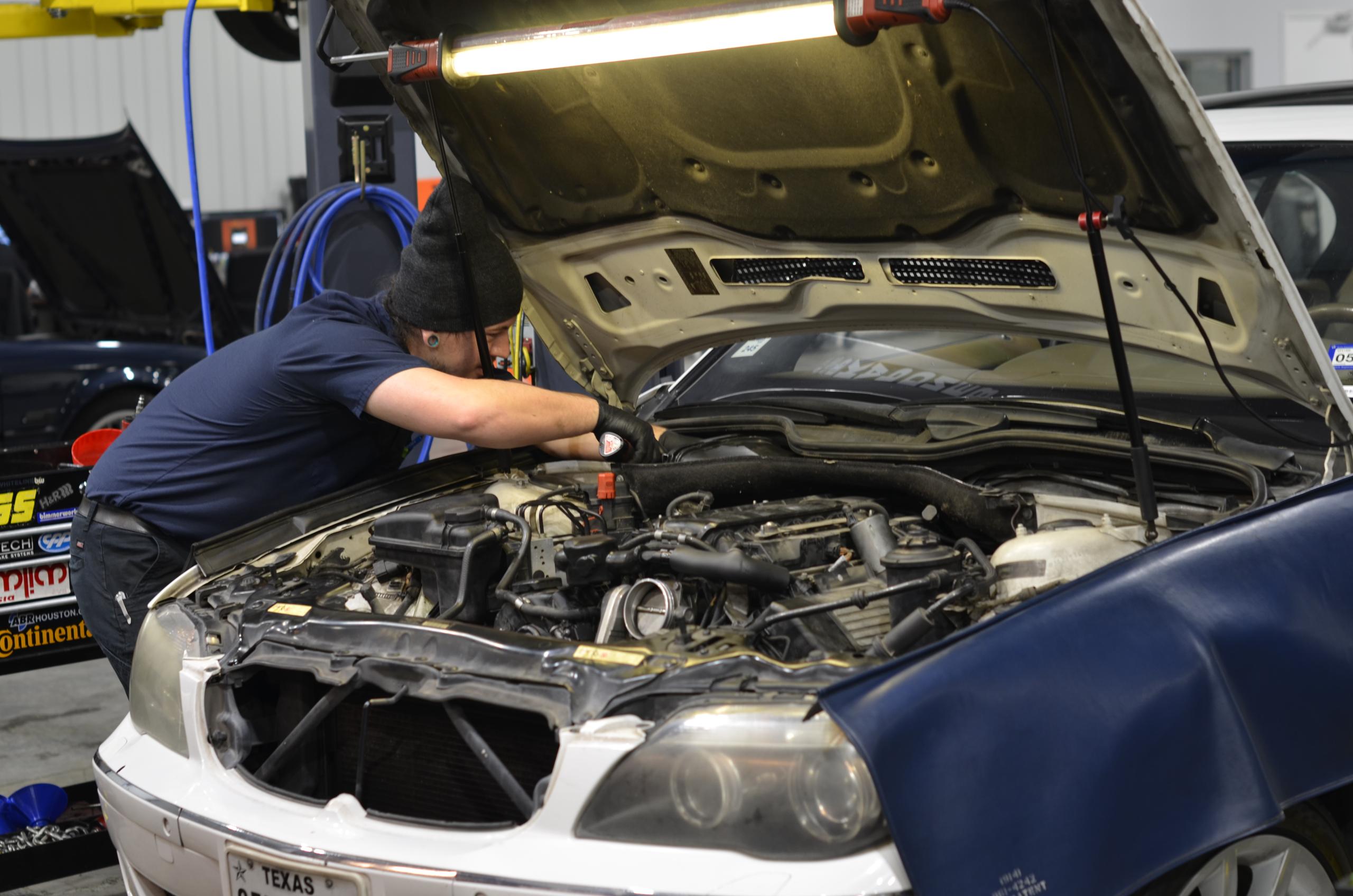
What ABR Houston Checks When a BMW Has a Drivetrain Malfunction
Diagnosis should be based on the specific vehicle and symptoms rather than a predetermined list of parts to replace.
At ABR Houston, the process begins with understanding what happened.
Useful information includes:
- When the warning appeared
- Whether the engine was cold or hot
- Whether you were accelerating
- Whether the engine began shaking
- Whether power was reduced
- Whether the check engine light flashed
- Whether restarting changed the symptoms
- Whether the problem has happened before
- Recent repairs or maintenance
From there, diagnosis may include scanning the appropriate vehicle systems, reviewing fault information and operating data, performing visual inspections, and carrying out targeted tests based on what we find.
Depending on the fault, that might mean checking ignition operation, fuel delivery, intake or boost leaks, electrical circuits, sensor data, or mechanical condition.
The objective is simple:
Identify the actual cause before recommending the repair.
Should You Clear the Drivetrain Malfunction Warning Yourself?
Clearing the warning doesn’t repair the underlying fault.
It can also erase information that may help a technician understand what happened.
If the warning has appeared, especially more than once, it’s usually better to leave the diagnostic information intact until the vehicle can be evaluated.
Take a picture of the warning if possible and make a note of what the car was doing when it appeared.
Those details can be useful when diagnosing an intermittent problem.
Schedule BMW Drivetrain Malfunction Diagnosis in Houston
A BMW drivetrain malfunction warning can come from several different systems, which is exactly why guessing at parts isn’t the best approach.
Sometimes the cause may be relatively straightforward. Other times, accurate diagnosis requires deeper testing.
ABR Houston specializes in BMW diagnostics, maintenance, and repair for drivers in Houston, The Woodlands, Spring, Tomball, and surrounding areas.
If your BMW is showing a drivetrain malfunction warning, losing power, misfiring, or running differently than normal, schedule BMW drivetrain malfunction diagnosis with ABR Houston before a small issue becomes a bigger repair.
Woodlands 832-797-9114 https://abr.digitalconcierge.io/link/nt2gEEVc-
Katy 281-579-8885 https://abr.digitalconcierge.io/link/z0AWvyXhk